Description
The Philippines, an archipelago of more than 7,000 islands, has nothing to envy to other countries on the Asian continent. Its territory is home to paradisiacal beaches, some of the most beautiful seabed in the world, amazing landscapes such as the green hills called “chocolate hills” or fantastic rice terraces. . Read more
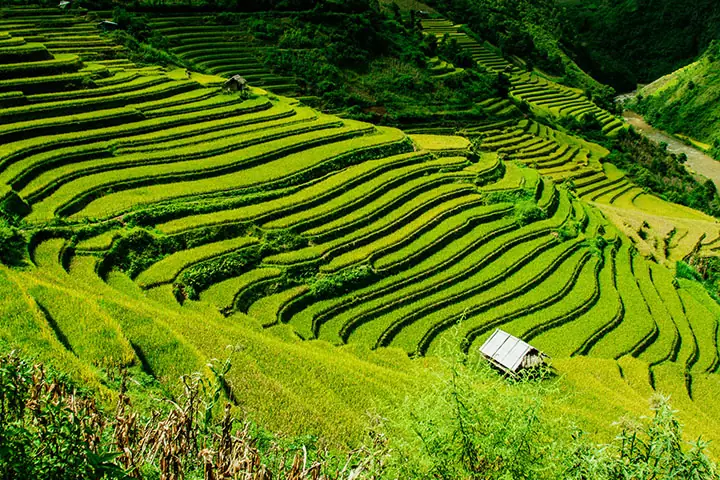
On this sensational trip we will see the major attractions of Manila and then go to the green and mountainous region of Banaue. Here we will see the fabulous rice terraces that are over 2,000 years old and are still in use today. The local inhabitants of the area cultivate the land and keep it in family clans but the land is not owned, passing from generation to generation.
From Banaue, we will visit the picturesque village of Sagada. Here on high limestone cliffs and among a pine forest we will find the hanging coffins, in what represents one of the most curious cemeteries in the world.
Finally, to end our trip we will have the opportunity to visit the island of Palawan, a paradise of spectacular beaches with white sand, turquoise waters, blue skies and impressive submarine bottoms.
Departure dates
Manila
Bacolor
Banaue
Sagada
Vigan
Puerto Princesa
Honda Bay
- Day 1
- Day 2
- Day 3
- Day 4
- Day 5
- Day 6
- Day 7
- Day 8
- Day 9
- Day 10
- Day 11
- Day 12
Itinerary
Day 1 – Spain – Manila
Departure by scheduled flight to Manila. Overnight on board.
Day 2 – Manila
Arrival in Manila, reception and transfer to the hotel. Rest of the day at leisure.
Lodging.
Day 3 – Manila
After breakfast, we will take a guided tour of the city to contemplate the rich history and culture of the capital of the Philippines and see the great contrast between the old and modern parts of the city. We will visit Rizal Park, the walled city of Intramuros, Fort Santiago and St. Augustine Church. Then we will visit Makati, the commercial and financial district of the capital.
Lodging.
Day 4 – Manila – Bacolor – Banaue
In the morning we will leave for Bacolor by road. Bacolor is one of the many villages that were devastated by the eruption of the Pinatubo volcano in 1993. We will visit the village and its basilica, of which only a quarter remains visible today. We will be able to see how the houses of the old village were reduced to a collection of roofs at street level.
The trip will continue through the countryside, passing through villages and towns surrounded by rice fields where you can observe the simplicity of life of its inhabitants. On our way to Banaue we will pass through the provinces of Nueva Ecija and Nueva Vizcaya, stopping in the town of San Jose for lunch.
Between San Jose and Banaue we will be able to visit Dalton Pass, historical site of Santa Fe (Nueva Vizcaya), and Bagabag, with its picturesque mountains and rivers ascending to the lands of the Ifugao.
Arrival in Banue in the afternoon and transfer to the hotel.
Accommodation.
Day 5 – Banaue
Breakfast. Today we will visit the viewpoint from where we can appreciate the grandeur and beauty of the Banaue Rice Terraces. Thousands of kilometers of mountains, covered from top to bottom by terraces sculpted by hand by the Ifugaos with prehistoric tools.
A hike from the village of Hapao will give us the opportunity to see first hand this wonder of the world.
Once the tour is over, we can return to our hotel or visit the Ifugaos’ villages and meet their indigenous tribes.
Lodging.
Day 6 – Banaue – Sagada
Breakfast. Today we leave Banaue for Sagada, with a stop at the Bontoc Museum.
Sagada is a very particular village, with pine forests, hanging coffins, subway caves (used as burial grounds by the indigenous people), limestone cliffs and waterfalls.
If time permits, we can also visit other points of interest, such as the Bokong Waterfalls, Danom Lake or the weaving stores.
Lodging.
Day 7 – Sagada – Vigan
Breakfast. Today we leave Sagada for Vigan.
Vigan was a Spanish settlement established in the 15th century. It retains its colonial charm with its cobblestone streets, horse-drawn carriages (calesas) and its mix of Filipino and Spanish architecture.
In the afternoon, we will visit the Heritage Village of Vigan, one of the six UNESCO World Heritage Sites in the Philippines. We will also visit the “Stone Houses” (Bahay na Bato), built with adobe. These houses have handcrafted furniture of the time.
If time permits, we will visit other places of interest such as: the mausoleum of Juan Luna, Pagbuynayan (where pots are handcrafted), the Balauerte Zoo, the Syquia Mansions, the Salcedo and Burgos Square, the Cathedral of San Pablo, the Archbishop’s Palace or the Crisologo Mansion.
Lodging.
Day 8 – Vigan – Manila
Breakfast.
Early morning departure from Vigan to Manila, stopping in La Union for lunch on the beach.
In the afternoon we will arrive in Manila and transfer to our hotel.
Lodging.
Day 9 – Manila – Puerto Princesa
Breakfast.
Today we will head to Puerto Princesa, capital of the island of Palawan.
At sunset we will be able to see the spectacle of the Fireflies of the Iwahig River, before dinner at a local restaurant.
Overnight.
Day 10 -PuertoPrincesa – Honda Bay
After breakfast, we will make an excursion to Honda Bay and its 7 islets. Beautiful corner of the Philippines that stands out for its rich seabed. That is why diving and snorkeling are two of the most demanded and recommended activities in the bay.
During the day we will enjoy picnics, snorkeling, swimming in the crystal clear waters or feeding the fish.
Lodging.
Day 11 – Puerto Princesa – Underground River
Breakfast. Today we will make an excursion to the Puerto Princesa Subterranean River.
Named a World Heritage Site, this natural wonder has 8.2 km of navigable river and is therefore considered the longest subway river in the world. It flows through a spectacular cave before emptying into the West Philippine Sea.
Lodging.
Day 12 – Puerto Princesa – Spain
Breakfast. Transfer to the airport to take the flight back to Spain.
Note: it is possible to customize the itinerary by adding more days or visiting other destinations such as El Nido, Coron, Bohol or Cebu.
Prices per person
|
Price (Based on 4 persons) |
Price (Based on 2 persons) |
| 2.590 € | 3.490 € |
More information about prices
What does it include?
Flights
International flights Spain – Manila / Puerto Princesa – Spain
Domestic flights Manila – Puerto Princesa (max. 7kg carry-on baggage and 20kg checked baggage)
Transfers
Transfers airport – hotel – airport with English-speaking guide
Meals
All breakfasts in Manila and Bohol
Staff
All excursions / activities indicated in the itinerary, group around 16 people, with Spanish speaking guide on days 3 to 7 and with English speaking guide on days 9 to 11.
Insurance
Travel insurance. Check here the conditions
24-hour telephone assistance
Lodging
Lodging in the indicated hotels or similar in double occupancy rooms
* Consult supplement for superior rooms


What is NOT included?
Seasonal supplement
Expenses arising from adverse weather or flight delays
Tips
Extras not specified
Practical information
Situation
An archipelago of 7,107 islands located approximately 100 km southeast of the Asian continent, in the Western Pacific. All these small islands that make up the country are divided into 3 main groups: Luzon, Visayas, and Mindanao.
Recommended time of year
The best time to visit the country is from November to March.
Weather
The climate of the Philippines is tropical, therefore it is a hot and humid environment. The average temperature is 26 to 27 degrees Celsius; and it is generally divided into two seasons: dry and wet. The dry season goes from December to June, being the first months cooler and drier and from March to June, very hot and dry. The rainy and typhoon season runs from June to November (most notable in Manila and the northern part of Luzon Island).
Documentation
Passport with at least six months of validity.
Vaccines
None mandatory. However, vaccination against tetanus, diphtheria, polio, typhoid and hepatitis A and B is recommended.
Languages
English and Filipino. Local dialects are also spoken.
Currency
Philippine weight.
It is advisable to carry cash (US dollars). Credit cards are accepted in the capital, Manila, but there are not many banks in rural areas.
Time difference
GMT+8:00.
Electricity
220 V and 110 V. In some places an adapter may be required.
What to bring
Comfortable, light and casual clothing, hiking boots, raincoat, some warm clothes for the northern mountainous regions, flip-flops, shorts, swimsuit, sun hat, sunscreen, binoculars, camera or video camera and sunglasses.
Remarks
Upon departure at the international airport, a departure tax of 550 pesos or US$ 10 to be paid only in Philippine currency is mandatory for all passengers with international destinations.